
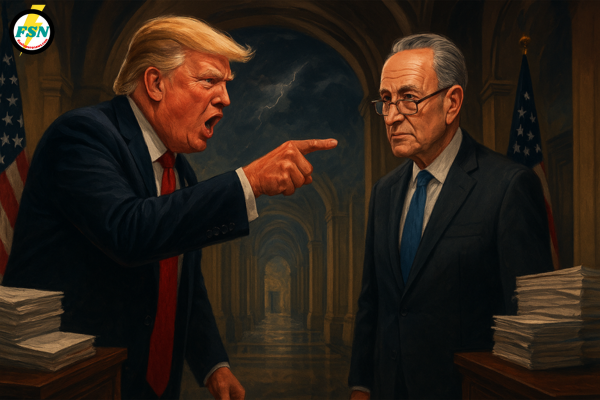
Trump’s Fiery Accusation: Why He Calls It the “Disastrous Schumer Shutdown”

As the U.S. government shutdown stretches into its 18th day, political tensions in Washington have reached a boiling point. Former President Donald Trump has once again taken to social media to slam Senate Majority Leader Chuck Schumer, calling the ongoing crisis the “Disastrous Schumer Shutdown.” Trump’s remarks come amid rising frustration among federal workers, economic uncertainty, and an ever-deepening divide between Republicans and Democrats.
According to Trump, the “Disastrous Schumer Shutdown” represents more than just a budget stalemate—it symbolizes what he describes as a complete collapse of Democratic leadership. He accused Schumer of failing the American people by prioritizing political games over national progress. Trump’s choice of words, loaded with anger and conviction, mirrors his familiar rhetorical style, rallying his supporters while putting Democrats on the defensive.
The phrase “Disastrous Schumer Shutdown” has quickly gained traction among conservative circles online, becoming a rallying cry for those who blame Schumer for the government’s closure. Trump’s supporters argue that Democrats are holding critical funding bills hostage to score political points, while millions of Americans are left without essential services. From national parks to federal offices, the shutdown’s effects are being felt across the country, amplifying public anger and uncertainty.
Economic analysts have also begun to warn of the long-term impact of the “Disastrous Schumer Shutdown.” With thousands of federal employees furloughed and government contracts stalled, the U.S. economy could face significant slowdowns if the impasse continues. Wall Street’s cautious response and declining investor confidence further underline the economic consequences of prolonged political deadlock.
In his latest statement, Trump declared that the “Disastrous Schumer Shutdown” is proof that Democrats have lost touch with ordinary Americans. He pointed to Schumer’s leadership as ineffective, claiming that while the nation waits for solutions, Washington is drowning in partisan bickering. Trump framed himself as the voice of reason amid chaos, promising that Republican-led leadership could restore stability and reopen the government swiftly.
Critics, however, argue that Trump’s labeling of the “Disastrous Schumer Shutdown” is politically motivated, designed to deflect blame from Republicans. They contend that the stalemate stems from mutual stubbornness rather than one man’s failure. Still, Trump’s framing has proven effective in shaping public perception, especially among his voter base.
As the shutdown continues to affect everyday Americans, the phrase “Disastrous Schumer Shutdown” remains at the heart of the nation’s political conversation. Whether it becomes a lasting symbol of Democratic mismanagement or a temporary partisan slogan depends on how quickly Congress can find a path forward. For now, Trump’s fiery accusation ensures that the term dominates headlines — and keeps the pressure firmly on Schumer’s shoulders.
Inside Washington’s Deadlock: How the “Disastrous Schumer Shutdown” Paralyzed the Nation
The “Disastrous Schumer Shutdown” has thrown Washington into one of its most chaotic political gridlocks in recent memory. As the government shutdown drags into its 18th day, frustration mounts on Capitol Hill and across the nation. Federal offices remain shuttered, vital programs are frozen, and millions of Americans are feeling the ripple effects of political dysfunction. Both parties continue to trade accusations, but former President Donald Trump has firmly placed the blame on Senate Majority Leader Chuck Schumer, branding the crisis as the “Disastrous Schumer Shutdown.”
At the heart of the “Disastrous Schumer Shutdown” lies a deep ideological divide between Democrats and Republicans over government spending, border security, and federal priorities. Negotiations have repeatedly collapsed as each side refuses to yield. For Schumer, maintaining party unity has proven difficult as pressure grows from both moderates seeking compromise and progressives demanding bold action. Meanwhile, Trump has seized the moment to position himself as the outspoken critic of Washington’s inefficiency, arguing that Schumer’s leadership failures have brought the government to a grinding halt.
The paralysis caused by the “Disastrous Schumer Shutdown” has extended beyond politics. Thousands of federal workers have gone without pay, national parks remain closed, and administrative delays have hit essential services such as small business loans and passport renewals. Economists warn that every passing day of inactivity chips away at the U.S. economy, affecting consumer confidence and market stability. For many Americans, the shutdown isn’t a distant political battle—it’s a direct hit to their livelihoods.
Inside the halls of Congress, tempers have flared. Lawmakers describe tense closed-door meetings filled with accusations and failed compromises. Republicans accuse Democrats of holding the budget hostage to push their agenda, while Democrats insist that GOP leaders are unwilling to negotiate fairly. Trump’s repeated use of the term “Disastrous Schumer Shutdown” has added fuel to the fire, keeping Schumer under constant public scrutiny and framing him as the face of dysfunction.
The longer the “Disastrous Schumer Shutdown” persists, the more it erodes public trust in government institutions. Polls indicate rising voter anger toward both parties, but Trump’s messaging strategy has effectively painted Schumer as the symbol of Washington’s paralysis. With the media amplifying Trump’s words, the narrative of a failed Democratic leadership continues to dominate headlines.
As the standoff shows no signs of resolution, Washington remains trapped in a web of blame and political brinkmanship. The “Disastrous Schumer Shutdown” stands as a stark reminder of how partisanship can grind the world’s most powerful government to a halt. For millions of Americans caught in the middle, the cost of political pride has never felt higher.
Economic Fallout Deepens as the “Disastrous Schumer Shutdown” Enters Its Third Week
The “Disastrous Schumer Shutdown” has now entered its third week, and the economic consequences are beginning to take a heavy toll across the United States. What began as a political standoff in Washington has evolved into a full-scale economic strain, impacting federal employees, small businesses, and financial markets alike. Former President Donald Trump continues to emphasize that this crisis is the direct result of failed Democratic leadership, repeatedly calling it the “Disastrous Schumer Shutdown” to highlight what he describes as Chuck Schumer’s inability to lead effectively.
From Wall Street to Main Street, the impact of the “Disastrous Schumer Shutdown” is visible everywhere. Government contractors have halted projects, small businesses that rely on federal permits are facing delays, and millions of dollars in daily economic activity have been frozen. Economists estimate that each week of the shutdown drains billions from the U.S. economy, creating uncertainty in sectors ranging from tourism to technology. With consumer confidence slipping and markets reacting cautiously, the shutdown’s long-term damage could extend far beyond government offices.
For federal workers, the “Disastrous Schumer Shutdown” has become a personal and financial nightmare. Over 800,000 employees are either furloughed or working without pay, struggling to meet mortgage payments, rent, and daily expenses. Social media is filled with stories of affected families turning to food banks and community aid programs to make ends meet. The emotional and financial stress is mounting, while Washington remains deadlocked with no solution in sight.
Trump’s continued criticism of Schumer underscores the political dimension of the crisis. He argues that the “Disastrous Schumer Shutdown” reflects not only poor negotiation but also a disregard for the economic stability of the country. By framing the issue around Schumer’s leadership, Trump has managed to rally his base and shift the national conversation, portraying Republicans as ready to act while Democrats block progress for political gain.
Meanwhile, financial experts warn that the “Disastrous Schumer Shutdown” could weaken economic growth if it continues much longer. Disrupted government spending affects everything from infrastructure projects to research grants, slowing progress in key industries. Analysts are also concerned about investor sentiment, as prolonged instability in Washington could trigger volatility in the stock market and undermine global confidence in U.S. governance.
As the “Disastrous Schumer Shutdown” drags into another week, Americans are growing weary of partisan blame and political theatrics. The financial pain is real, the uncertainty is deepening, and the patience of the public is wearing thin. Every passing day without resolution adds to the mounting cost—both economically and politically—of a shutdown that has become a national crisis.
Public Reaction and Political Blame Game Over the “Disastrous Schumer Shutdown”

The “Disastrous Schumer Shutdown” has ignited fierce debate across America, dividing public opinion and intensifying the political blame game between Democrats and Republicans. As the government shutdown drags into its third week, millions of citizens are expressing frustration and anger toward Washington’s leadership vacuum. While former President Donald Trump continues to label the crisis the “Disastrous Schumer Shutdown,” Democrats argue that the stalemate is the result of Republican stubbornness and political grandstanding.
Across the nation, public reaction to the “Disastrous Schumer Shutdown” has been both emotional and deeply personal. Federal workers and their families, directly affected by missed paychecks, have taken to social media to share their struggles. Airports are facing staff shortages, national parks are closed, and local economies dependent on government funding are beginning to feel the strain. For many Americans, the shutdown is no longer an abstract political fight—it’s a crisis that touches their daily lives, from delayed benefits to disrupted services.
Polls suggest that the “Disastrous Schumer Shutdown” is eroding public trust in both major parties, though Trump’s framing of the issue has gained traction among conservatives. Many Republican supporters echo his sentiment that Chuck Schumer and Democratic leaders are more focused on political positioning than governance. Trump’s repeated use of the term “Disastrous Schumer Shutdown” has amplified his message, keeping Schumer in the spotlight as the central figure blamed for the crisis.
Democrats, however, are pushing back with equal intensity. They argue that Trump’s rhetoric is designed to distract from Republican inflexibility and policy failures. In their view, the “Disastrous Schumer Shutdown” is not a Democratic problem but a symptom of deeper dysfunction within Washington’s political system. Progressive voices accuse Trump of using fear and division to manipulate public sentiment, while moderates call for compromise to end the stalemate and reopen the government.
The media’s coverage of the “Disastrous Schumer Shutdown” has further fueled polarization. Conservative outlets amplify Trump’s message of Democratic failure, while liberal commentators highlight the human cost of political brinkmanship. Cable news debates, opinion columns, and social media trends have turned the shutdown into a cultural flashpoint, where every statement becomes ammunition for partisan narratives.
As public frustration grows, both parties face increasing pressure to act. Americans are demanding accountability, not excuses. The “Disastrous Schumer Shutdown” has become a symbol of how deeply political gridlock can wound a nation’s confidence in its leaders. With every day that passes, the patience of the public wears thinner, and the demand for real solutions grows louder. The question now is whether Washington’s leaders will rise to the moment—or continue to let the “Disastrous Schumer Shutdown” define their failure to govern.
What’s Next for Congress? Possible Endgame to the “Disastrous Schumer Shutdown”
As the “Disastrous Schumer Shutdown” stretches into its third week, the question dominating Washington and the nation is clear: what’s next for Congress? With negotiations stalled and tempers flaring on both sides of the aisle, lawmakers face mounting pressure to deliver a solution before the economic and social damage deepens further. The “Disastrous Schumer Shutdown” has become not only a political standoff but a defining test of leadership for both parties.
Behind closed doors, discussions in Congress have intensified. Senior Republicans are urging Senate Majority Leader Chuck Schumer to agree to temporary funding measures to reopen critical government operations, while Democrats insist on addressing long-term policy concerns before any deal is made. Trump continues to hammer away at Schumer, framing the impasse as a leadership collapse and labeling the ongoing crisis as the “Disastrous Schumer Shutdown.” His persistent messaging has cornered Democrats into a defensive position, forcing them to justify their stance to an increasingly impatient public.
The longer the “Disastrous Schumer Shutdown” drags on, the more severe the consequences become. Congressional analysts warn that every passing day without a funding resolution compounds the strain on federal agencies, disrupts essential programs, and undermines public confidence in government. Bipartisan talks have been proposed, but mutual distrust continues to stall progress. Both sides know that compromise could come at a political cost—but failure to act could prove even more damaging in the long run.
Possible endgame scenarios for the “Disastrous Schumer Shutdown” range from a short-term continuing resolution to a grand bargain addressing multiple budget priorities. Some moderates in both chambers are quietly drafting a bipartisan framework that would temporarily reopen the government while deferring contentious issues to later negotiations. However, hardliners on both ends remain firm, making it difficult to bridge the ideological divide.
Trump’s strategy remains clear: keep public attention focused on Schumer and the Democrats by repeatedly emphasizing the “Disastrous Schumer Shutdown.” His framing of the crisis has proven effective in shaping headlines and rallying conservative support. For Schumer, the challenge lies in finding a path forward that protects his party’s policy priorities without appearing politically weakened.
Public patience is wearing thin, and economic warning signs are flashing red. If Congress fails to break the impasse soon, the “Disastrous Schumer Shutdown” could leave long-lasting scars on both the economy and America’s political landscape. With businesses slowing, families struggling, and global investors watching closely, the next few days may determine not just the end of the shutdown—but the credibility of Washington’s leadership itself.